
Spanish learning guide
How to learn Spanish fast
If you want to know how to learn Spanish fast, start with words you are likely to hear and read again, then keep reviewing them until you can recall them. Vocabulum X teaches the 10,000 most common Spanish words in frequency order. Its flashcards use your answer and the time you took to recall a word to schedule its next review. Pair that vocabulary practice with Spanish reading, listening and conversation, where the words begin to take on meaning beyond their English translations.
Start with the Spanish words that appear most often
Frequency changes how useful your early study time can be. A word that appears across many conversations gives you repeated chances to recognize it. Small Spanish words such as de and que may look less memorable than a noun from a themed lesson, yet they appear in sentences about nearly every subject.
In a study based on a 20-million-word Spanish corpus, linguist Mark Davies found that the 1,000 most frequent word entries accounted for 87.8% of spoken word occurrences, 79.6% of fiction and 76% of nonfiction. Those figures measure how often words occur. They do not mean that knowing 1,000 translations lets you understand 87.8% of a conversation. An unfamiliar verb can still carry the point of a sentence.
The figures do show why the first 1,000 words deserve attention. Davies also found that each later group of 1,000 added less coverage than the one before it. Learning common vocabulary first puts the words with the most opportunities for use at the beginning of your study, while later levels continue into the less frequent words you need for wider reading and conversation.
Remember the word when you meet it again
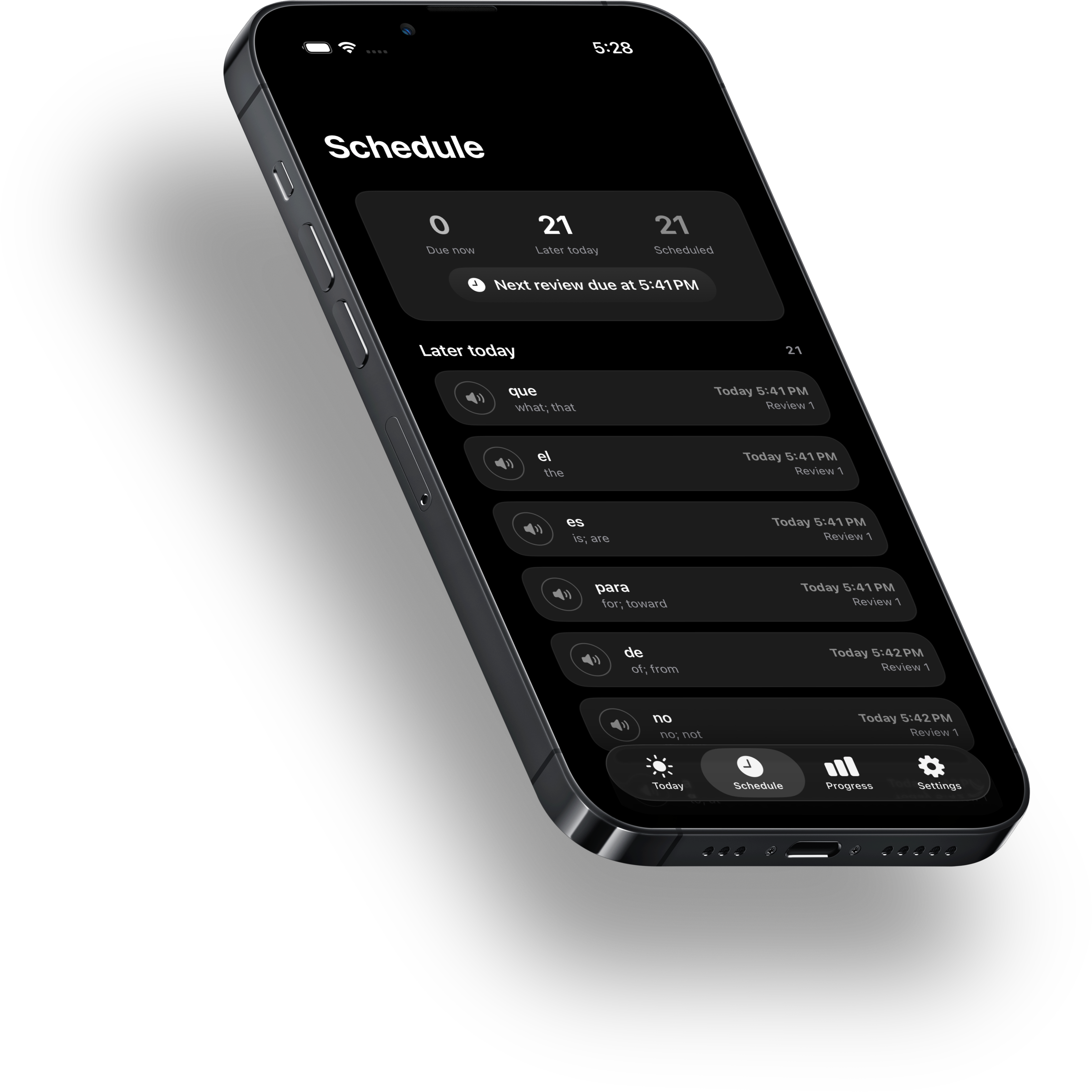
Recognizing a translation once is a start. Recalling it next week takes practice across time. In a foreign-vocabulary study using a web app, spaced study and feedback improved later recall. Vocabulum X applies spaced reviews to each word you study, bringing missed words back sooner and giving readily recalled words longer intervals.
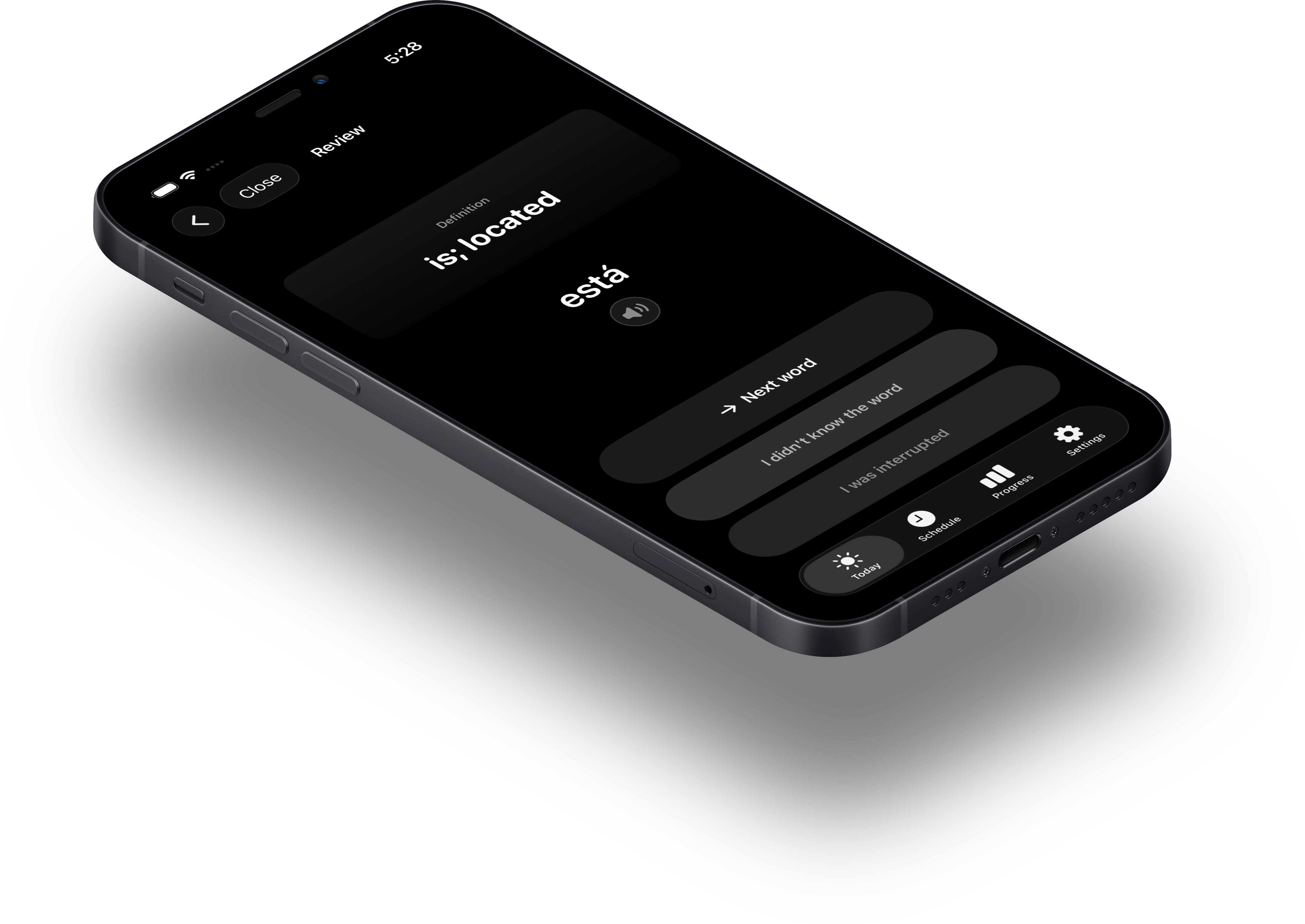
The 30-second flashcard timer adds another piece of information. Answering "I know the word" in three seconds shows easier recall than reaching the answer near the end of the timer. Vocabulum X uses response time alongside your answer to set the next review. After seeing the English translation, you can correct an answer if you realize you had the meaning wrong. You can also record an interruption during the timer.
Choose a daily target between 10 and 100 new Spanish words. That target controls new introductions; all previously studied words due for review remain on your schedule. The words are arranged in five levels, beginning with the first 1,000 and continuing to 10,000. The next level opens after you have reviewed every word in the current one once, while earlier words continue to return when due.
Spanish learning resources for reading, listening and grammar
A translation cannot tell you everything a Spanish sentence is doing. The form fue, for example, can come from either ser or ir. Its meaning depends on the sentence around it. Davies discusses this ambiguity in his work on counting Spanish words. It is a good reason to use your growing vocabulary in real sentences and to study verb forms alongside it.
For reading, the Instituto Cervantes offers Lecturas paso a paso, with texts arranged by difficulty and accompanied by activities. For listening, its En sintonía con el español provides audio and transcripts for learners from A2 onward. The Catálogo de voces hispánicas has recorded speech and transcripts from different Spanish-speaking regions, so you can hear how the language sounds beyond one accent.
Use a short passage or recording after your word reviews. Notice the familiar words first, then look at the surrounding sentence to understand how they are being used. When a form such as fue or a choice such as ser and estar stops you, give that grammar point its own practice. Speaking with another person gives you a further test: whether you can bring a word to mind when you need it.
Return to the common words you still hesitate over
Frequency-based study is useful after your first Spanish course, too. In a study of 953 university learners of Spanish, even students in advanced courses had gaps among the 3,000 most frequent words. Someone returning to Spanish can move through familiar flashcards and find common words that still take time to recall.
That gives you a concrete place to resume. Review the frequent words you already know, spend more time with the ones you hesitate over, and take those words into the Spanish you read, hear and speak.